The Byzantine Empire originated in AD 395 from the definitive subdivision of the Roman Empire into two distinct political entities: the Western Empire and the Eastern Empire. While the Western Empire disappeared in 476, due to Germanic invasions, the Eastern Empire endured for centuries. During Justinian’s reign (527-565) a good portion of the western territories were reconquered for a time and the Empire retained a distinctive ‘Roman’ nature at least until the reign of Heraclius (610-641). But during his reign, the Eastern Empire came under attack from the expanding Muslim Arabs, losing a much of its original Eastern territories. With Imperial power weakened and restricted largely to the Balkans and Anatolia, the ‘Roman’ nature of the Eastern Empire became progressively more Greek and transformed into what we know as ‘the Byzantine Empire’ (though they called themselves Romans to the end).
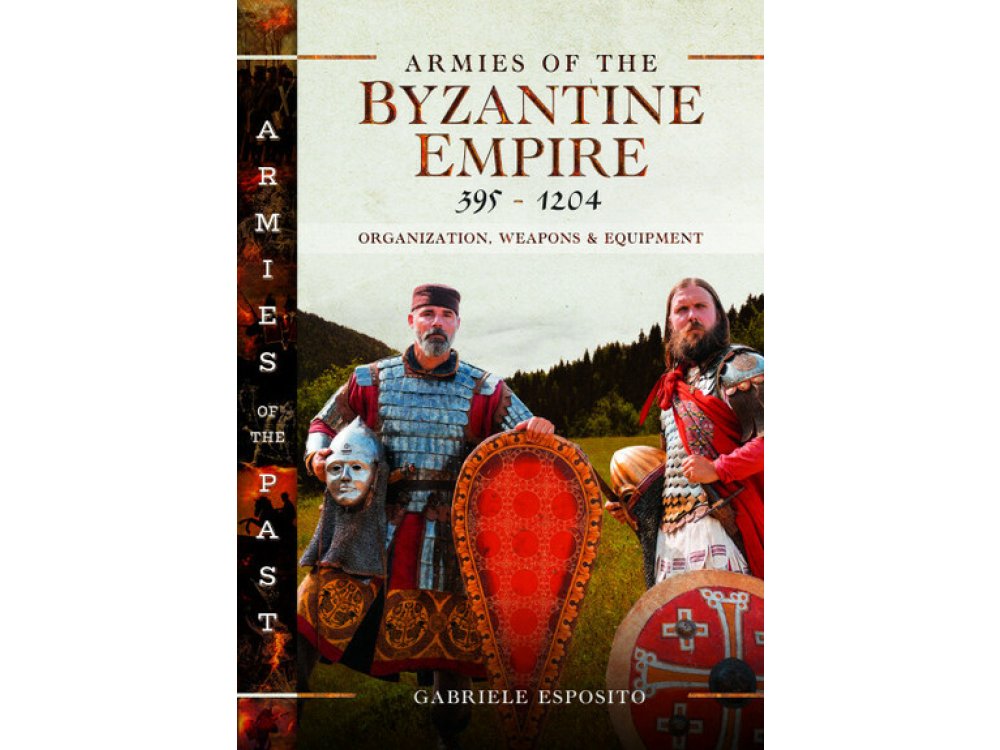
Despite being surrounded by enemies, the Byzantines defended their remaining domains for a further half a millenium, their territories expanding and contracting with fluctuating fortunes. This tenacious survival was largely due to the ability of their military to adapt (as Roman armies always had) to emerging threats from a wide variety of enemies. The Byzantine Empire collapsed only in 1204, when attacked by forces of the Fourth Crusade, its ostensible allies. In addition to presenting an overview and analysis of the various campaigns of the period, Gabriele Esposito provides a complete review of Byzantine military organization, weapons, tactics and equipment. The clear text is lavishly illustrated with dozen of colour photographs of replica arms, armour and costume in use.
Συγγραφέας: Esposito Gabriele
Εκδότης: PEN AND SWORD BOOKS
Σελίδες: 184
ISBN: 9781036112929
Εξώφυλλο: Σκληρό Εξώφυλλο
Αριθμός Έκδοσης: 1
Έτος έκδοσης: 2025
Gabriele Esposito is an Italian researcher and a long-time student of military history, whose interests and expertise range widely over various periods. Most of his recent studies have been dedicated to the reconstruction of the organization, functioning and tactics of the armies across history; in each of his publications there is always some relevant space dedicated to the 'material culture'of the various armies taken into account and - more in particular - to the empirical science known as 'uniformology'. Gabriele is the author of numerous books on armies and uniforms and is a regular contributor to many specialized magazines in Italy, France, Netherlands and UK. His many previous works include Armies of Early Colonial North America 1607-1713; Armies of the Late Roman Empire 284-476; Armies of the Hellenistic States 323 BC to AD30; Armies of Celtic Europe 700 BC-AD 106; Armies of Ancient Greece, circa 500 BC to 338 BC; and The Macedonian Army of Philip II and Alexander the Great 359-323 BC, all published by Pen & Sword since 2018. He lives in southern Italy, near the ancient battlefield of Beneventum.
Περιγραφή
The Byzantine Empire originated in AD 395 from the definitive subdivision of the Roman Empire into two distinct political entities: the Western Empire and the Eastern Empire. While the Western Empire disappeared in 476, due to Germanic invasions, the Eastern Empire endured for centuries. During Justinian’s reign (527-565) a good portion of the western territories were reconquered for a time and the Empire retained a distinctive ‘Roman’ nature at least until the reign of Heraclius (610-641). But during his reign, the Eastern Empire came under attack from the expanding Muslim Arabs, losing a much of its original Eastern territories. With Imperial power weakened and restricted largely to the Balkans and Anatolia, the ‘Roman’ nature of the Eastern Empire became progressively more Greek and transformed into what we know as ‘the Byzantine Empire’ (though they called themselves Romans to the end).
Despite being surrounded by enemies, the Byzantines defended their remaining domains for a further half a millenium, their territories expanding and contracting with fluctuating fortunes. This tenacious survival was largely due to the ability of their military to adapt (as Roman armies always had) to emerging threats from a wide variety of enemies. The Byzantine Empire collapsed only in 1204, when attacked by forces of the Fourth Crusade, its ostensible allies. In addition to presenting an overview and analysis of the various campaigns of the period, Gabriele Esposito provides a complete review of Byzantine military organization, weapons, tactics and equipment. The clear text is lavishly illustrated with dozen of colour photographs of replica arms, armour and costume in use.
Χρησιμοποιούμε cookies για να έχετε μια προσωποποιημένη εμπειρία, την εξατομίκευση περιεχομένου και διαφημίσεων, την παροχή λειτουργιών social media και την ανάλυση της επισκεψιμότητάς μας. Επιπλέον, μοιραζόμαστε πληροφορίες για τον τρόπο που χρησιμοποιείτε τον ιστότοπό μας με συνεργάτες social media, διαφήμισης και αναλύσεων.