Προσθήκη στα αγαπημένα
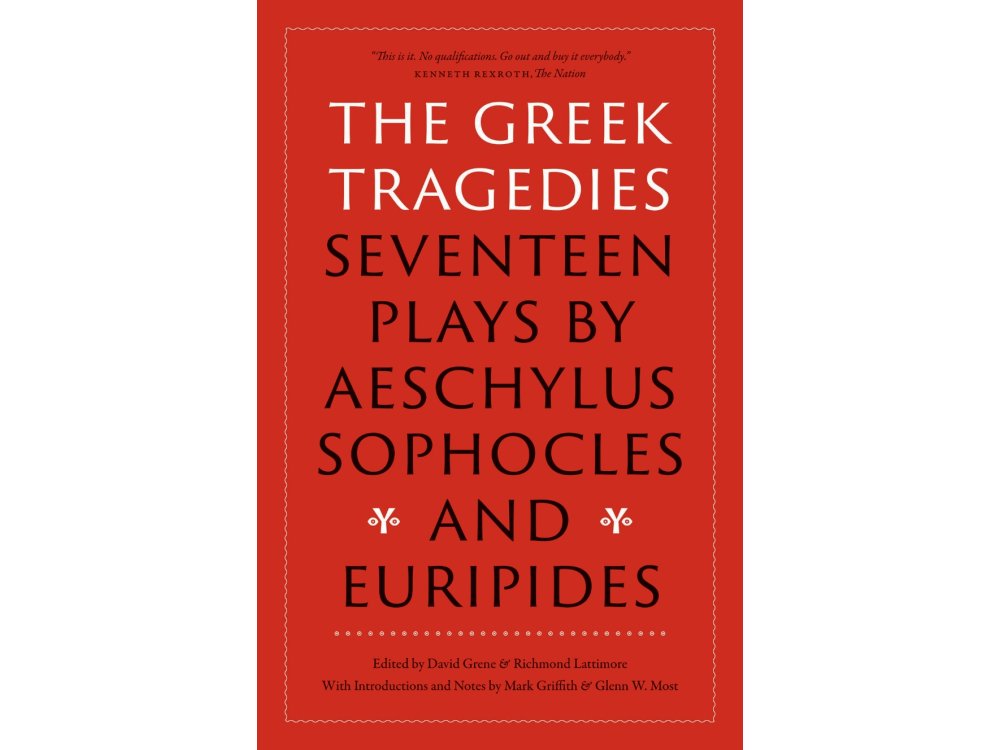
Chicago’s renowned translations of the greatest surviving plays of ancient Greece, collected into a single volume.
Drawn from the authoritative third editions of David Grene and Richmond Lattimore’s collections of the complete Greek tragedies, expertly updated by Mark Griffith and Glenn W. Most, this collection brings together seventeen of the greatest surviving plays of ancient Greece. Combining accuracy, poetic immediacy, and clarity of presentation, the masterpieces of Aeschylus, Sophocles, and Euripides have been rendered so compellingly in English that they remain the definitive translations. Each text has been carefully updated to bring it even closer to the ancient Greek original while retaining the vibrancy for which Chicago’s versions are famous.
Alongside the plays, this edition includes an introduction to the life and work of each tragedian; an introduction to each play offering essential information about its first production, plot, and reception through the centuries; and notes addressing textual uncertainties. Featuring lively translations by eminent classicists and authors including Anne Carson, Robert Fitzgerald, David Grene, Richmond Lattimore, Oliver Taplin, Emily Townsend Vermeule, and Elizabeth Wyckoff, this is an indispensable anthology for any reader of the foundational works of Western drama, art, and life.
How the Plays Were Originally Staged
I. Aeschylus
Introduction to Aeschylus
The Persians, Translated by Seth Benardete
Prometheus Bound, Translated by David Grene
The Oresteia
Agamemnon, Translated by Richmond Lattimore
The Libation Bearers, Translated by Richmond Lattimore
The Eumenides, Translated by Richmond Lattimore
II. Sophocles
Introduction to Sophocles
The Theban Plays
Antigone, Translated by Elizabeth Wyckoff
Oedipus the King, Translated by David Grene
Oedipus at Colonus, Translated by Robert Fitzgerald
Electra, Translated by David Grene
III. Euripides
Introduction to Euripides
Alcestis, Translated by Richmond Lattimore
Medea, Translated by Oliver Taplin
Hippolytus, Translated by David Grene
Hecuba, Translated by William Arrowsmith
Electra, Translated by Emily Townsend Vermeule
The Trojan Women, Translated by Richmond Lattimore
Iphigenia among the Taurians, Translated by Anne Carson
The Bacchae, Translated by William Arrowsmith
Textual Notes
Περιγραφή
Chicago’s renowned translations of the greatest surviving plays of ancient Greece, collected into a single volume.
Drawn from the authoritative third editions of David Grene and Richmond Lattimore’s collections of the complete Greek tragedies, expertly updated by Mark Griffith and Glenn W. Most, this collection brings together seventeen of the greatest surviving plays of ancient Greece. Combining accuracy, poetic immediacy, and clarity of presentation, the masterpieces of Aeschylus, Sophocles, and Euripides have been rendered so compellingly in English that they remain the definitive translations. Each text has been carefully updated to bring it even closer to the ancient Greek original while retaining the vibrancy for which Chicago’s versions are famous.
Alongside the plays, this edition includes an introduction to the life and work of each tragedian; an introduction to each play offering essential information about its first production, plot, and reception through the centuries; and notes addressing textual uncertainties. Featuring lively translations by eminent classicists and authors including Anne Carson, Robert Fitzgerald, David Grene, Richmond Lattimore, Oliver Taplin, Emily Townsend Vermeule, and Elizabeth Wyckoff, this is an indispensable anthology for any reader of the foundational works of Western drama, art, and life.