Προσθήκη στα αγαπημένα
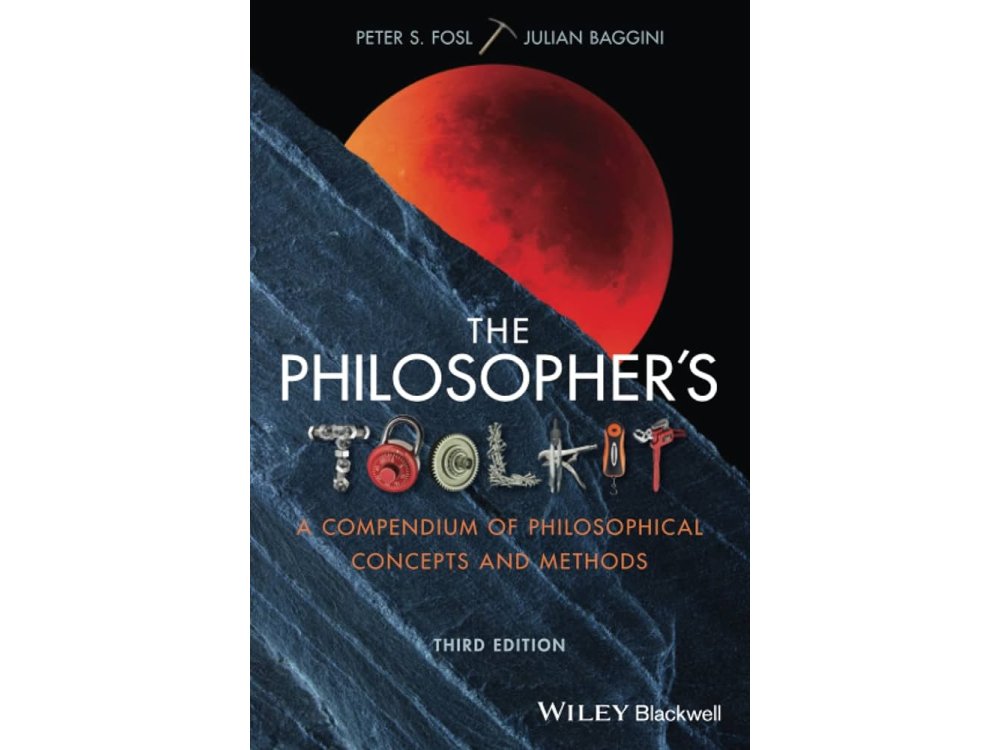
A new edition of the bestselling guide to the study of philosophy: the ideal intellectual ‘toolkit’ for sharpening analytical skills and building philosophical acuity
Whether used as a guide to basic principles or a resource for key concepts and methods, The Philosopher's Toolkit equips readers with all the intellectual ‘tools’ necessary for engaging closely with philosophical argument and developing fluency in the methods and language of philosophical inquiry. Featuring accessible explanations, practical examples, and expert guidance, this text empowers readers to understand traditional philosophical thinking and to engage with new ideas.
Focuses on the practical methods and concepts necessary for philosophical inquiry
Presents a versatile resource for both novice and advanced students in areas of philosophy, critical theory, and rhetoric
Adopts a pluralistic approach to teaching philosophy, making this a suitable resource for many courses
Delivers extensive cross-referenced entries, recommended readings, and updated online resources
Covers an array of topics, from basic tools of argumentation to sophisticated philosophical principles
Fully revised and updated to include new topics and entries as well as expanded recommended reading lists to encourage further study
Acknowledgements xiii
Alphabetical Table of Contents xv
Preface xix
Internet Resources for Philosophers xxi
1 Basic Tools for Argument 1
1.1 Arguments, premises, and conclusions 1
1.2 Deduction 7
1.3 Induction 9
1.4 Validity and soundness 15
1.5 Invalidity 19
1.6 Consistency 21
1.7 Fallacies 25
1.8 Refutation 28
1.9 Axioms 31
1.10 Definitions 34
1.11 Certainty and probability 38
1.12 Tautologies, self‐contradictions, and the law of non‐contradiction 42
2 More Advanced Tools 47
2.1 Abduction 47
2.2 Hypothetico‐deductive method 51
2.3 Dialectic 55
2.4 Analogies 58
2.5 Anomalies and exceptions that prove the rule 61
2.6 Intuition pumps 64
2.7 Logical constructions 66
2.8 Performativity and speech acts 69
2.9 Reduction 72
2.10 Representation 76
2.11 Thought experiments 80
2.12 Useful fictions 82
3 Tools for Assessment 85
3.1 Affirming, denying, and conditionals 86
3.2 Alternative explanations 90
3.3 Ambiguity and vagueness 93
3.4 Bivalence and the excluded middle 97
3.5 Category mistakes 100
3.6 Ceteris paribus 102
3.7 Circularity 104
3.8 Composition and division 108
3.9 Conceptual incoherence 110
3.10 Contradiction/contrariety 112
3.11 Conversion, contraposition, obversion 115
3.12 Counterexamples 118
3.13 Criteria 121
3.14 Doxa/para‐doxa 123
3.15 Error theory 125
3.16 False dichotomy 128
3.17 False cause 129
3.18 Genetic fallacy 132
3.19 Horned dilemmas 135
3.20 Is/ought gap 138
3.21 Masked man fallacy 141
3.22 Partners in guilt 143
3.23 Principle of charity 145
3.24 Question‐begging 149
3.25 Reductios 152
3.26 Redundancy 154
3.27 Regresses 156
3.28 Saving the phenomena 158
3.29 Self‐defeating arguments 161
3.30 Sufficient reason 164
3.31 Testability 167
4 Tools for Conceptual Distinctions 171
4.1 A priori/a posteriori 172
4.2 Absolute/relative 176
4.3 Analytic/synthetic 179
4.4 Belief/knowledge 182
4.5 Categorical/modal 185
4.6 Cause/reason 186
4.7 Conditional/biconditional 189
4.8 De re/de dicto 191
4.9 Defeasible/indefeasible 194
4.10 Entailment/implication 196
4.11 Endurantism/perdurantism 199
4.12 Essence/accident 202
4.13 Internalism/externalism 205
4.14 Knowledge by acquaintance/description 208
4.15 Mind/body 211
4.16 Necessary/contingent 215
4.17 Necessary/sufficient 219
4.18 Nothingness/being 221
4.19 Objective/subjective 225
4.20 Realist/non‐realist 227
4.21 Sense/reference 230
4.22 Substratum/bundle 232
4.23 Syntax/semantics 234
4.24 Universal/particular 236
4.25 Thick/thin concepts 239
4.26 Types/tokens 241
5 Tools of Historical Schools and Philosophers 245
5.1 Aphorism, fragment, remark 245
5.2 Categories and specific differences 248
5.3 Elenchus and aporia 251
5.4 Hegel’s master/slave dialectic 254
5.5 Hume’s fork 257
5.6 Indirect discourse 260
5.7 Leibniz’s law of identity 263
5.8 Ockham’s razor 267
5.9 Phenomenological method(s) 270
5.10 Signs and signifiers 273
5.11 Transcendental argument 276
6 Tools for Radical Critique 281
6.1 Class critique 281
6.2 Différance, deconstruction, and the critique of presence 284
6.3 Empiricist critique of metaphysics 286
6.4 Feminist and gender critiques 289
6.5 Foucaultian critique of power 292
6.6 Heideggerian critique of metaphysics 296
6.7 Lacanian critique 298
6.8 Critiques of naturalism 300
6.9 Nietzschean critique of Christian–Platonic culture 303
6.10 Pragmatist critique 305
6.11 Sartrean critique of ‘bad faith’ 308
7 Tools at the Limit 311
7.1 Basic beliefs 311
7.2 Godel and incompleteness 314
7.3 Hermeneutic circle 316
7.4 Philosophy and/as art 319
7.5 Mystical experience and revelation 322
7.6 Paradoxes 325
7.7 Possibility and impossibility 328
7.8 Primitives 332
7.9 Self‐evident truths 334
7.10 Scepticism 337
7.11 Underdetermination and incommensurability 341
Index 345
Περιγραφή
A new edition of the bestselling guide to the study of philosophy: the ideal intellectual ‘toolkit’ for sharpening analytical skills and building philosophical acuity
Whether used as a guide to basic principles or a resource for key concepts and methods, The Philosopher's Toolkit equips readers with all the intellectual ‘tools’ necessary for engaging closely with philosophical argument and developing fluency in the methods and language of philosophical inquiry. Featuring accessible explanations, practical examples, and expert guidance, this text empowers readers to understand traditional philosophical thinking and to engage with new ideas.
Focuses on the practical methods and concepts necessary for philosophical inquiry
Presents a versatile resource for both novice and advanced students in areas of philosophy, critical theory, and rhetoric
Adopts a pluralistic approach to teaching philosophy, making this a suitable resource for many courses
Delivers extensive cross-referenced entries, recommended readings, and updated online resources
Covers an array of topics, from basic tools of argumentation to sophisticated philosophical principles
Fully revised and updated to include new topics and entries as well as expanded recommended reading lists to encourage further study