Add to wishlist
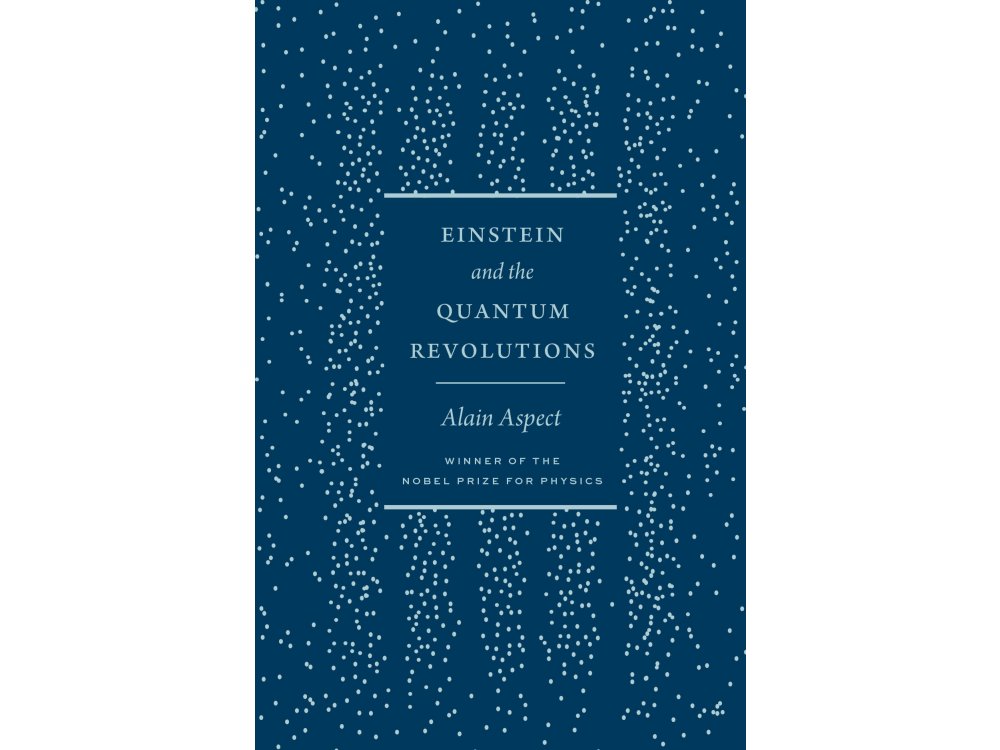
A Nobel laureate offers a brief lesson on physics’ biggest mystery, accessibly explaining the two quantum revolutions that changed our understanding of reality.
At the start of the twentieth century, the first quantum revolution upset our vision of the world. New physics offered surprising realities, such as wave-particle duality, and led to major inventions: the transistor, the laser, and today’s computers. Less known is the second quantum revolution, arguably initiated in 1935 during a debate between giants Albert Einstein and Niels Bohr. This revolution is still unfolding. Its revolutionaries—including the author of this short accessible book, Nobel Prize–winning physicist Alain Aspect—explore the notion of entangled particles, able to interact at seemingly impossible distances. Aspect’s research has helped to show how entanglement may both upend existing technologies, like cryptography, and usher in entirely new ones, like quantum computing. Explaining this physics of the future, this work tells a story of how philosophical debates can shape new realities.
Foreword by David Kaiser
Two Quantum Revolutions
The First Quantum Revolution
Wave-Particle Duality
The Success of the First Quantum Revolution
The Second Quantum Revolution
Entanglement Measurement Experiments
The Manipulation of Quantum Objects
Quantum Information
Quantum Cryptography
In Search of the Limit
About the Author
Description
A Nobel laureate offers a brief lesson on physics’ biggest mystery, accessibly explaining the two quantum revolutions that changed our understanding of reality.
At the start of the twentieth century, the first quantum revolution upset our vision of the world. New physics offered surprising realities, such as wave-particle duality, and led to major inventions: the transistor, the laser, and today’s computers. Less known is the second quantum revolution, arguably initiated in 1935 during a debate between giants Albert Einstein and Niels Bohr. This revolution is still unfolding. Its revolutionaries—including the author of this short accessible book, Nobel Prize–winning physicist Alain Aspect—explore the notion of entangled particles, able to interact at seemingly impossible distances. Aspect’s research has helped to show how entanglement may both upend existing technologies, like cryptography, and usher in entirely new ones, like quantum computing. Explaining this physics of the future, this work tells a story of how philosophical debates can shape new realities.