Add to wishlist
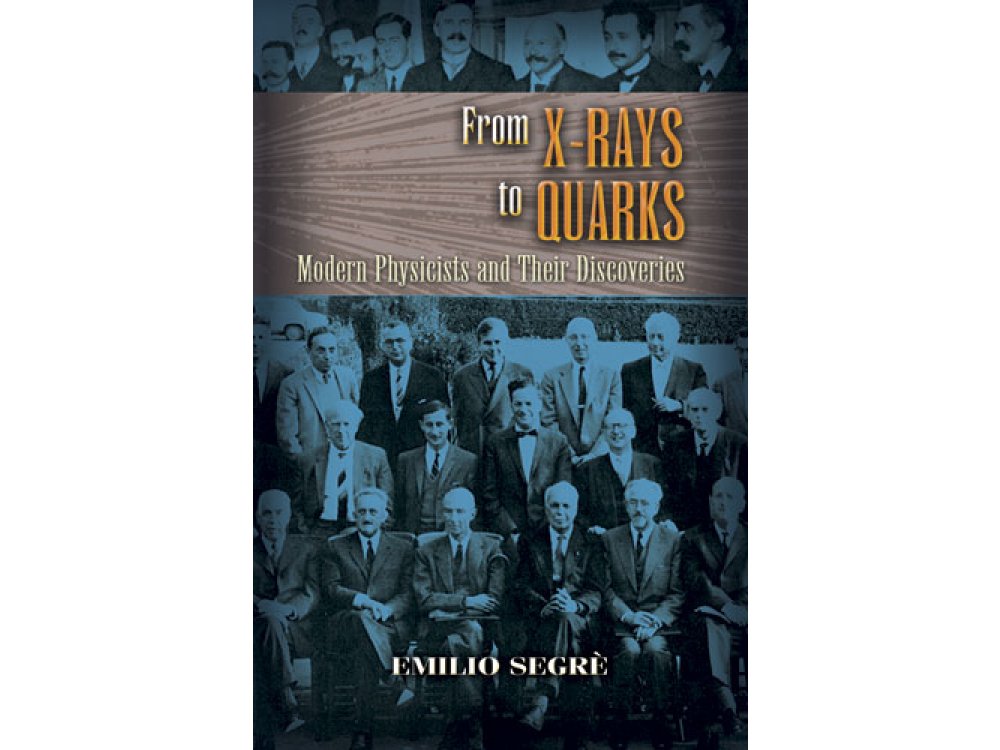
A leading figure in twentieth-century physics offers impressions and recollections of the field's development. Nobel Laureate Emilio Segre (1905–89) knew and worked with many of modern physics' preeminent scientists. In this simple but elegant history, he offers compelling views not only of the milestones of scientific discovery but also the personalities involved—their attitudes and politics as well as their trials and triumphs. Highlights include a profile of Albert Einstein, from his unconventional youth to his role as science's elder statesman; the wonder year of 1932, which witnessed the discoveries of the neutron, positron, and deuterium; and the first steps in building particle accelerators.
A student and colleague of Enrico Fermi, Segre made numerous important contributions to nuclear physics, including participation in the Manhattan Project. Segre is further renowned for his narrative skills as a historian. This book is a companion to the author's From Falling Bodies to Radio Waves: Classical Physicists and Their Discoveries, also available from Dover Publications.
Preface
1. Introduction
2. H. Becquerel, the Curies, and the Discovery of Radioactivity
3. Rutherford in the New World: The Transmutation of Elements
4. Planck, Unwilling Revolutionary: The Idea of Quantization
5. Einstein--New Ways of Thinking: Space, Time, Relativity, and Quanta
6. Sir Ernest and Lord Rutherford of Nelson
7. Bohr and Atomic Models
8. A True Quantum Mechanics at Last
9. The Wonder Year 1932: Neutron, Positron, Deuterium, and Other Discoveries
10. Enrico Fermi and Nuclear Energy
11. E. O. Lawrence and Particle Accelerators
12. Beyond the Nucleus
13. New Branches from the Old Stump
Conclusions
Appendix 1. Stefan's law. Wien's law.
Appendix 2. Planck's hunt for the blackbody radiation formula
Appendix 3. Einstein's heuristic argument for postulating the existence of light quanta
Appendix 4. Brownian motion
Appendix 5. Blackbody energy fluctuations according to Einstein
Appendix 6. Specific heat of solids according to Einstein
Appendix 7. A and B of Einstein
Appendix 8. J. J. Thomson's parabola method for finding elm of ions
Appendix 9. Bohr's hydrogen atom
Appendix 10. Quantum mechanics in a nutshell
Bibliography
Name Index
Subject Index
Description
A leading figure in twentieth-century physics offers impressions and recollections of the field's development. Nobel Laureate Emilio Segre (1905–89) knew and worked with many of modern physics' preeminent scientists. In this simple but elegant history, he offers compelling views not only of the milestones of scientific discovery but also the personalities involved—their attitudes and politics as well as their trials and triumphs. Highlights include a profile of Albert Einstein, from his unconventional youth to his role as science's elder statesman; the wonder year of 1932, which witnessed the discoveries of the neutron, positron, and deuterium; and the first steps in building particle accelerators.
A student and colleague of Enrico Fermi, Segre made numerous important contributions to nuclear physics, including participation in the Manhattan Project. Segre is further renowned for his narrative skills as a historian. This book is a companion to the author's From Falling Bodies to Radio Waves: Classical Physicists and Their Discoveries, also available from Dover Publications.