Add to wishlist
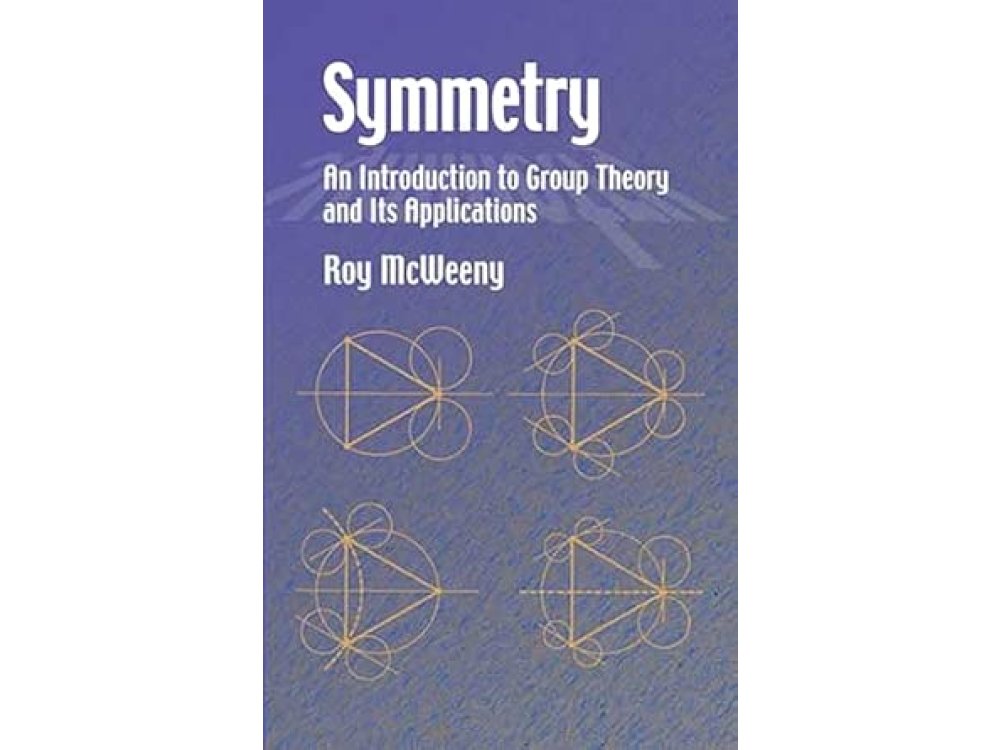
The crucial significance of symmetry to the development of group theory and in the fields of physics and chemistry cannot be overstated, and this well-organized volume provides an excellent introduction to the topic.
The text develops the elementary ideas of both group theory and representation theory in a progressive and thorough fashion, leading students to a point from which they can proceed easily to more elaborate applications. The finite groups describing the symmetry of regular polyhedral and of repeating patterns are emphasized, and geometric illustrations of all main processes appear here — including more than 100 fully worked examples.
Designed to be read at a variety of levels and to allow students to focus on any of the main fields of application, this volume is geared toward advanced undergraduate and graduate physics and chemistry students with the requisite mathematical background.
Preface
Chapter 1. Groups
1.1 Symbols and the group property
1.2 Definition of a group
1.3 The multiplication table
1.4 Powers, products, generators
1.5 Subgroups, cosets, classes
1.6 Invariant subgroups. The factor group
1.7 Homomorphisms and isomorphisms
1.8 Elementary concept of a representation
1.9 The direct product
1.10 The algebra of a group
Chapter 2. Lattices and vector spaces
2.1 Lattices. One dimension
2.2 Lattices. Two and three dimensions
2.3 Vector spaces
2.4 n-Dimensional space. Basis vectors
2.5 Components and basis changes
2.6 Mappings and similarity transformations
2.7 Representations. Equivalence
2.8 Length and angle. The metric
2.9 Unitary transformations
2.10 Matrix elements as scalar products
2.11 The eigenvalue problem
Chapter 3. Point and space groups
3.1 Symmetry operations as orthogonal transformations
3.2 The axial point groups
3.3 The tetrahedral and octahedral point groups
3.4 Compatibility of symmetry operations
3.5 Symmetry of crystal lattices
3.6 Derivation of space groups
Chapter 4. Representations of point and translation groups
4.1 Matrices for point group operations
4.2 Nomenclature. Representations
4.3 Translation groups. Representations and reciprocal space
Chapter 5. Irreducible representations
5.1 Reducibility. Nature of the problem
5.2 Reduction and complete reduction. Basic theorems
5.3 The orthogonality relations
5.4 Group characters
5.5 The regular representation
5.6 The number of distinct irreducible representations
5.7 Reduction of representations
5.8 Idempotents and projection operators
5.9 The direct product
Chapter 6. Applications Involving Algebraic Forms
6.1 Nature of applications
6.2 Invariant forms. Symmetry restrictions
6.3 Principal axes. The eigenvalue problem
6.4 Symmetry considerations
6.5 Symmetry classification of molecular vibrations
6.6 Symmetry coordinates in vibration theory
Chapter 7. Applications involving functions and operators
7.1 Transformation of functions
7.2 Functions of Cartesian coordinates
7.3 Operator equations. Invariance
7.4 Symmetry and the eigenvalue problem
7.5 Approximation methods. Symmetry functions
7.6 Symmetry functions by projection
7.7 Symmetry functions and equivalent functions
7.8 Determination of equivalent functions
Chapter 8. Applications involving tensors and tensor operators
8.1 Scalar, vector and tensor properties
8.2 Significance of the metric
8.3 Tensor properties. Symmetry restrictions
8.4 Symmetric and antisymmetric tensors
8.5 Tensor fields. Tensor operators
8.6 Matrix elements of tensor operators
8.7 Determination of coupling coefficients
Appendix 1. Representations carried by harmonic functions
Appendix 2. Alternative bases for cubic groups
Index
Description
The crucial significance of symmetry to the development of group theory and in the fields of physics and chemistry cannot be overstated, and this well-organized volume provides an excellent introduction to the topic.
The text develops the elementary ideas of both group theory and representation theory in a progressive and thorough fashion, leading students to a point from which they can proceed easily to more elaborate applications. The finite groups describing the symmetry of regular polyhedral and of repeating patterns are emphasized, and geometric illustrations of all main processes appear here — including more than 100 fully worked examples.
Designed to be read at a variety of levels and to allow students to focus on any of the main fields of application, this volume is geared toward advanced undergraduate and graduate physics and chemistry students with the requisite mathematical background.