Add to wishlist
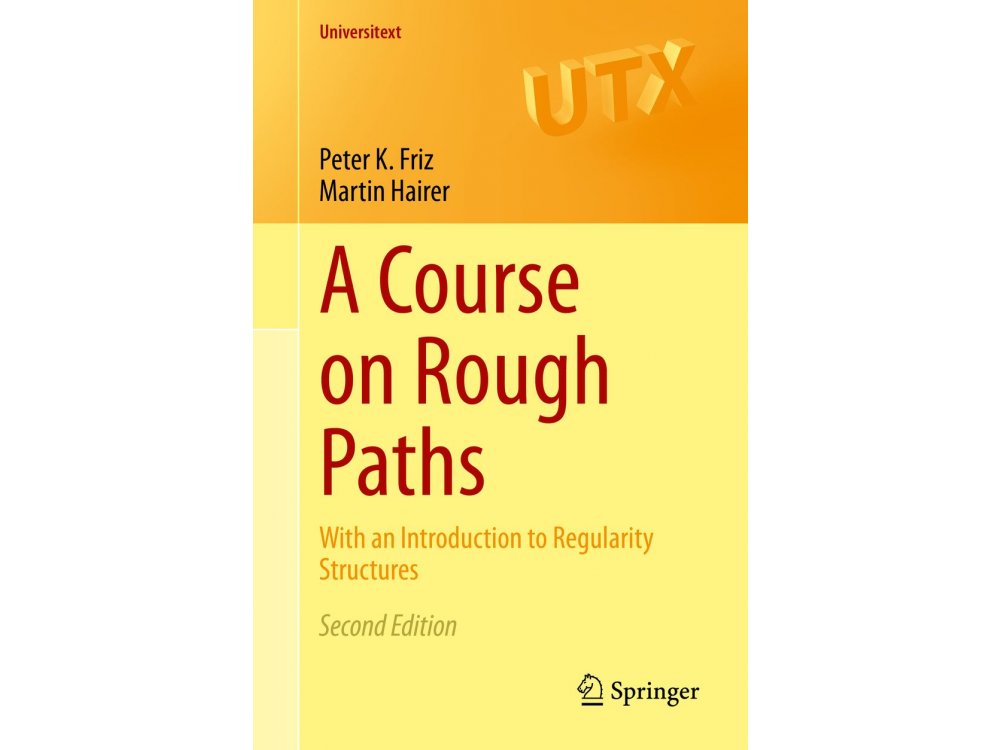
With many updates and additional exercises, the second edition of this book continues to provide readers with a gentle introduction to rough path analysis and regularity structures, theories that have yielded many new insights into the analysis of stochastic differential equations, and, most recently, stochastic partial differential equations.
Rough path analysis provides the means for constructing a pathwise solution theory for stochastic differential equations which, in many respects, behaves like the theory of deterministic differential equations and permits a clean break between analytical and probabilistic arguments. Together with the theory of regularity structures, it forms a robust toolbox, allowing the recovery of many classical results without having to rely on specific probabilistic properties such as adaptedness or the martingale property.
Essentially self-contained, this textbook puts the emphasis on ideas and short arguments, rather than aiming for the strongest possible statements. A typical reader will have been exposed to upper undergraduate analysis and probability courses, with little more than Itô-integration against Brownian motion required for most of the text.
Peter K. Friz is presently Einstein Professor of Mathematics at TU and WIAS Berlin. His previous professional affiliations include Cambridge University and Merrill Lynch, and he holds a PhD from the Courant Institute of New York University. He has made contributions to the understanding of the Navier-Stokes equation as dynamical system, pioneered new asymptotic techniques in financial mathematics and has written many influential papers on the applications of rough path theory to stochastic analysis, ranging from the interplay of rough paths with Malliavin calculus to a (rough-) pathwise view on non-linear SPDEs. Jointly with N. Victoir he authored a monograph on stochastic processes as rough paths.
1 Introduction.- 2 The space of rough paths.- 3 Brownian motion as a rough path.- 4 Integration against rough paths.- 5 Stochastic integration and Itô’s formula.- 6 Doob–Meyer type decomposition for rough paths.- 7 Operations on controlled rough paths.- 8 Solutions to rough differential equations.- 9 Stochastic differential equations.- 10 Gaussian rough paths.- 11 Cameron–Martin regularity and applications.- 12 Stochastic partial differential equations.- 13 Introduction to regularity structures.- 14 Operations on modelled distributions.- 15 Application to the KPZ equation.- References.- Index.
Description
With many updates and additional exercises, the second edition of this book continues to provide readers with a gentle introduction to rough path analysis and regularity structures, theories that have yielded many new insights into the analysis of stochastic differential equations, and, most recently, stochastic partial differential equations.
Rough path analysis provides the means for constructing a pathwise solution theory for stochastic differential equations which, in many respects, behaves like the theory of deterministic differential equations and permits a clean break between analytical and probabilistic arguments. Together with the theory of regularity structures, it forms a robust toolbox, allowing the recovery of many classical results without having to rely on specific probabilistic properties such as adaptedness or the martingale property.
Essentially self-contained, this textbook puts the emphasis on ideas and short arguments, rather than aiming for the strongest possible statements. A typical reader will have been exposed to upper undergraduate analysis and probability courses, with little more than Itô-integration against Brownian motion required for most of the text.
Peter K. Friz is presently Einstein Professor of Mathematics at TU and WIAS Berlin. His previous professional affiliations include Cambridge University and Merrill Lynch, and he holds a PhD from the Courant Institute of New York University. He has made contributions to the understanding of the Navier-Stokes equation as dynamical system, pioneered new asymptotic techniques in financial mathematics and has written many influential papers on the applications of rough path theory to stochastic analysis, ranging from the interplay of rough paths with Malliavin calculus to a (rough-) pathwise view on non-linear SPDEs. Jointly with N. Victoir he authored a monograph on stochastic processes as rough paths.

.jpg)