Add to wishlist
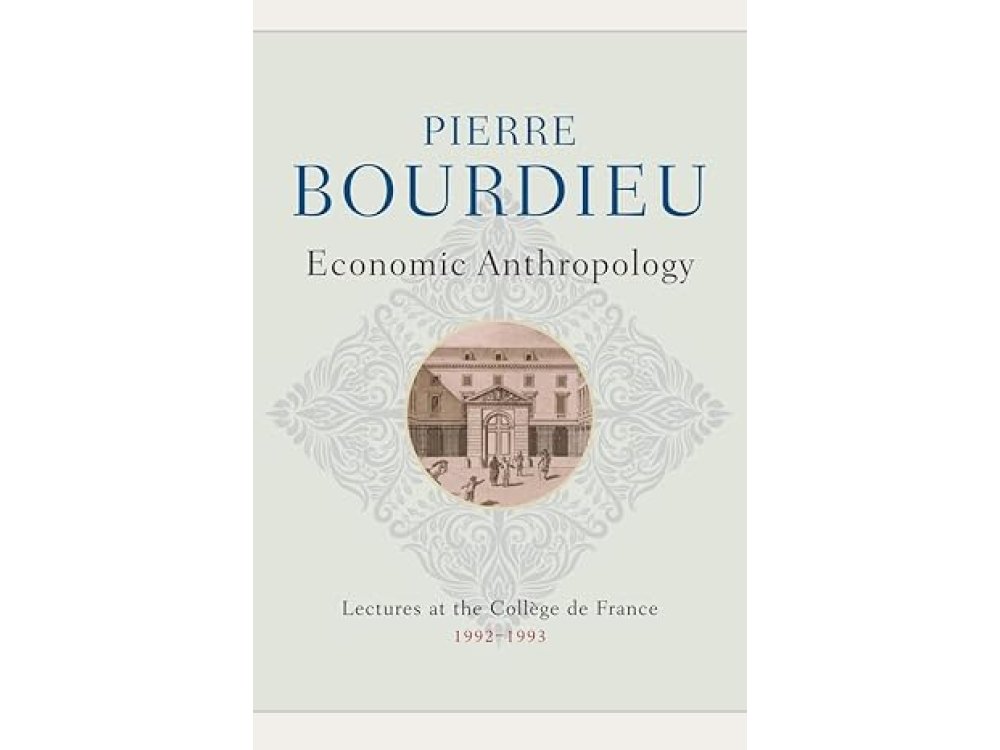
Has the revolution that led from the economy of the gift, characteristic of most precapitalist societies, to the economy of modern societies been accomplished in all spheres of life, as tacitly assumed by those who claim to apply the model of the profit-optimizing agent to every practice – to art, to education and even to marriage, seen as an exchange of economic services of production and reproduction? And is it totally accomplished even at the heart of the sphere most directly concerned with economic activity – the world of business?
These and many other questions are absent from the dominant economic theories, which fail to take account of the economic and social conditions under which economic agents and their universe arise. In his lectures at the Collège de France in 1987-89, Pierre Bourdieu laid bare the assumptions of the imaginary anthropology that underlies economics in its dominant form and put forward an alternative view. He replaced the notion of a pure and perfect market with the notion of an economic field structured by the unequal distribution of different forms of capital and by relations of force and symbolic struggle. He replaced homo economicus – that sovereign individual with no qualities or qualifications other than a capacity for rational calculation – with an agent endowed with enduring dispositions, fashioned by social background and experience, both individual and collective. And thus, without having to appeal to a perfectly lucid calculating mind or to the logic of bounded rationality, he was able to account for the alignment of subjective expectations and objective opportunities that confers on the great majority of economic behaviour its 'reasonable' character.
Bourdieu's trenchant critique of dominant economic thought and his development of an alternative way of understanding economic activity, rooted in his notion of field and his theory of practice, will be of great interest to students and scholars in anthropology, sociology, economics and throughout the social sciences and humanities.
Editorial note
Lecture of 1 April 1993
Preamble: rethinking the problems of economics - The theory of rational action - The dehistoricization of economic universes and behaviour - The case of the gift - The phenomenological approach to the gift (Derrida) - The anthropological analysis of the gift - Reintegrating lived experience and creating theory of practice - The destruction of time in science - The scholastic point of view
Lecture of 8 April 1993
Questions from the audience: the audacity of philosophers - The error of projecting the counter-gift into the gift - Overcoming the subjectivist and objectivist visions of the gift - Three differences - Discouraging the spirit of calculation in pre-capitalist economies - Economic dispositions and collective repression - Enchanted economic relations - The foundations of collective misrecognition - The nostalgia for lost paradises
Lecture of 29 April 1993
Obeying the rules and self-deception - The economics of symbolic wealth - Forgetting the historical and economic conditions of economic behaviour - The rise of calculability
Lecture of 6 May 1993
Symbolic revolutions and the overthrowing of categories - The co-genesis of the economic world and economic discourse - The universal falsehood of the calculating mind - The model of exchange - Challenge and attack by contempt - Collective expectations (1) - The gift and power - Collective expectations (2)
Lecture of 13 May 1993
The symbolic economy and the limitations of economic economics - The construction of lasting relations through symbolic exchange - Permanently recreating belief - The myth of the imperialism of the market and resistance to commercialization - The symbolic dimension of economic relations, the example of the labour contract - Symbolic logic in consumption - The economic conditions of rational behaviour
Lecture of 27 May 1993
Sociologists and economists - An a-historical reductivism - A double dehistoricization - For a historicist rationalism - The definition of the market - The historical conditions of pure theory
Lecture of 3 June 1993
The impossible definition of the market - Economic theory against itself - The economic field as a field of forces - The immanent tendencies of the economic field - The effect of distinction and competition
Lecture of 10 June 1993
The notion of the market in Max Weber - The indirect conflict - Harrison White’s model - Homology and second-degree choice for consumers - A three-fold break with Weber - The State creates the market: the example of the market in private housing
Lecture of 17 June 1993
Questions from the audience - Classification struggles in the economic field - The three postulates of homo oeconomicus - First alternative: the individual and the collective - (Socially) limited rationality - Second alternative: purposiveness and mechanism - The purposive illusion - Third alternative: the micro and the macro
Situating the lectures on ‘The social foundations of economic action’ in the works of Pierre Bourdieu
Julien Duval
Postface: Economics and the social sciences
Robert Boyer
Appendix: Summary of the lectures as published in the Annals of the Collège de France
Notes
Index
Description
Has the revolution that led from the economy of the gift, characteristic of most precapitalist societies, to the economy of modern societies been accomplished in all spheres of life, as tacitly assumed by those who claim to apply the model of the profit-optimizing agent to every practice – to art, to education and even to marriage, seen as an exchange of economic services of production and reproduction? And is it totally accomplished even at the heart of the sphere most directly concerned with economic activity – the world of business?
These and many other questions are absent from the dominant economic theories, which fail to take account of the economic and social conditions under which economic agents and their universe arise. In his lectures at the Collège de France in 1987-89, Pierre Bourdieu laid bare the assumptions of the imaginary anthropology that underlies economics in its dominant form and put forward an alternative view. He replaced the notion of a pure and perfect market with the notion of an economic field structured by the unequal distribution of different forms of capital and by relations of force and symbolic struggle. He replaced homo economicus – that sovereign individual with no qualities or qualifications other than a capacity for rational calculation – with an agent endowed with enduring dispositions, fashioned by social background and experience, both individual and collective. And thus, without having to appeal to a perfectly lucid calculating mind or to the logic of bounded rationality, he was able to account for the alignment of subjective expectations and objective opportunities that confers on the great majority of economic behaviour its 'reasonable' character.
Bourdieu's trenchant critique of dominant economic thought and his development of an alternative way of understanding economic activity, rooted in his notion of field and his theory of practice, will be of great interest to students and scholars in anthropology, sociology, economics and throughout the social sciences and humanities.